How Is Blockchain Changing Accounting?
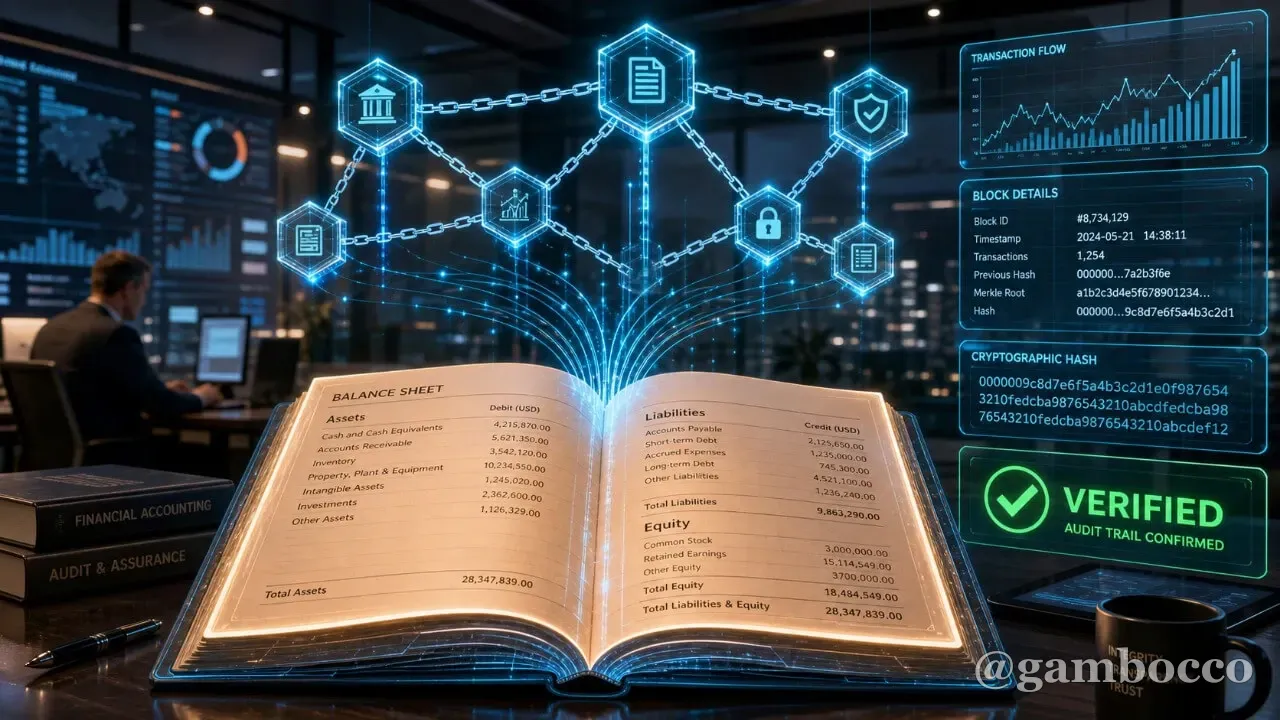
Blockchain is changing accounting by turning the general ledger from an internal book of record into a shared, tamper-evident source of truth that auditors, counterparties, and regulators can query in real time. This closes the gap between a transaction happening and its financial verification.
1. Triple-Entry Bookkeeping
Traditional bookkeeping is double-entry: debits and credits. Blockchain adds a third entry — a cryptographically signed record on a shared ledger visible to both counterparties and their auditor. This is called triple-entry bookkeeping, first proposed by Yuji Ijiri in 1989 and finally practical thanks to blockchain.
2. Continuous Auditing Instead of Annual Snapshots
Audits currently look at a company once a year. On a blockchain-backed ledger, auditors can watch transactions as they happen, flagging anomalies in real time. Big Four firms (Deloitte, EY, KPMG, PwC) all now offer continuous audit services built on blockchain data feeds.
3. Automated Reconciliation
Because both parties in a transaction see the same on-chain record, reconciliation collapses from days of matching spreadsheets to a single hash comparison. Enterprise deployments have documented 60–80% time savings in month-end close. Related: blockchain for GRC.
4. Fraud Reduction
The Association of Certified Fraud Examiners estimates organizations lose about 5% of annual revenue to fraud. Blockchain closes off several vectors: journal-entry manipulation, ghost invoices, and undisclosed related-party transactions. It doesn't stop collusion at the input layer — see the oracle problem discussion.
5. Faster Close Cycles
Traditional monthly close: 5–15 business days. Blockchain-enabled close for early adopters: 1–3 days, in some cases near-continuous. This changes the cadence of management reporting and investor communication.
6. Real-Time Regulatory Reporting
Financial regulators (SEC, FCA, BaFin, MAS) are actively piloting direct-read access to permissioned ledgers of regulated entities. In this model, quarterly filings become query outputs rather than assembled documents. See blockchain financial transparency.
7. Smart-Contract-Driven Controls
Internal controls — segregation of duties, approval thresholds, journal-entry restrictions — are traditionally enforced by process and reviewed by audit. Smart contracts enforce them at the transaction level: violations cannot even be attempted.
What This Means for the Accounting Profession
The routine bookkeeping and reconciliation work that occupied a large share of accountant hours is being automated. The value shift is toward interpretation, control design, forensic analysis, and blockchain assurance — where auditors read chains, verify smart contracts, and evaluate control frameworks.