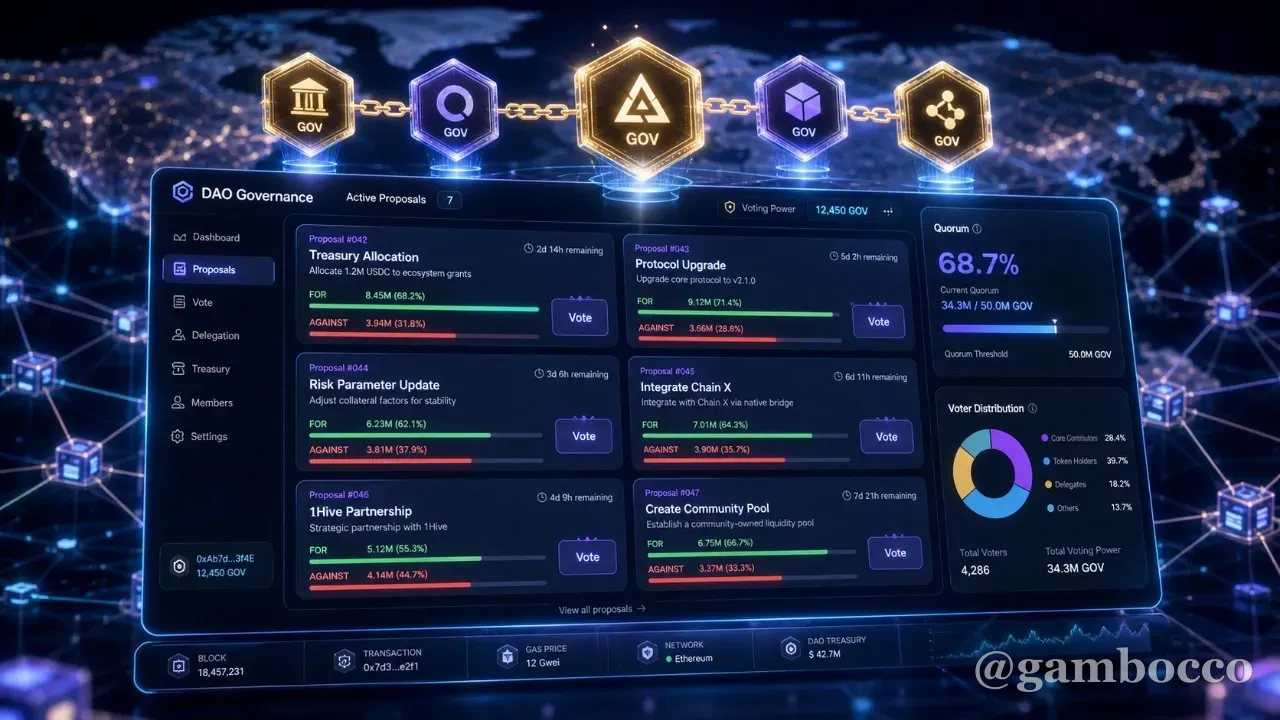
What Is Decentralized Governance With Blockchain?
Decentralized governance with blockchain is a system where the rules of an organization are enforced by smart contracts and decisions are made by token-holder or member votes recorded on-chain, rather than by a centralized board or hierarchy. The most common implementation is the DAO — Decentralized Autonomous Organization.
How a DAO Actually Runs a Decision
- A member submits a proposal (funding, upgrade, policy change).
- A discussion period occurs on off-chain forums like Discourse.
- Token holders vote on-chain (or via signed messages tallied by Snapshot).
- If a quorum + majority is reached, a smart contract executes the outcome — releasing funds, upgrading code, or updating parameters.
Real Deployments to Study
- MakerDAO — governs the DAI stablecoin with billions in on-chain collateral.
- Uniswap — governs the largest decentralized exchange by volume.
- Arbitrum — governs a leading Ethereum L2 with a treasury exceeding $2 billion.
- ENS DAO — governs the .eth naming standard.
- Optimism — pioneered a bicameral 'Citizens' House + Token House' governance design.
Voting Mechanisms Beyond 'One Token, One Vote'
Naive token voting concentrates power in whales. Modern DAOs use: quadratic voting (Gitcoin), conviction voting (1Hive), delegated voting (Compound), bicameral models (Optimism), and reputation tokens (SourceCred). Each trades off simplicity, sybil-resistance, and plutocracy differently.
What Blockchain Governance Is Good For
It works best when: the community is global (jurisdiction-agnostic), the treasury is fully on-chain (no legal enforcement gap), decisions are code-executable, and members' incentives align with the organization's long-term success — which is why Web3 protocols use it heavily.
Where It Struggles
It struggles with: low voter turnout (often under 5%), plutocratic capture, off-chain enforcement, legal ambiguity in most jurisdictions, and slow response to crises. This is why hybrid models — legally wrapped DAOs (Wyoming, Marshall Islands, Cayman) — are becoming the norm. Related reading: multi-sector governance review.
What's Next for DAO Governance
Expect zero-knowledge voting (privacy-preserving), AI-assisted proposal analysis, better delegate infrastructure, and the emergence of DAO-employed contributors as a mainstream category of digital work.