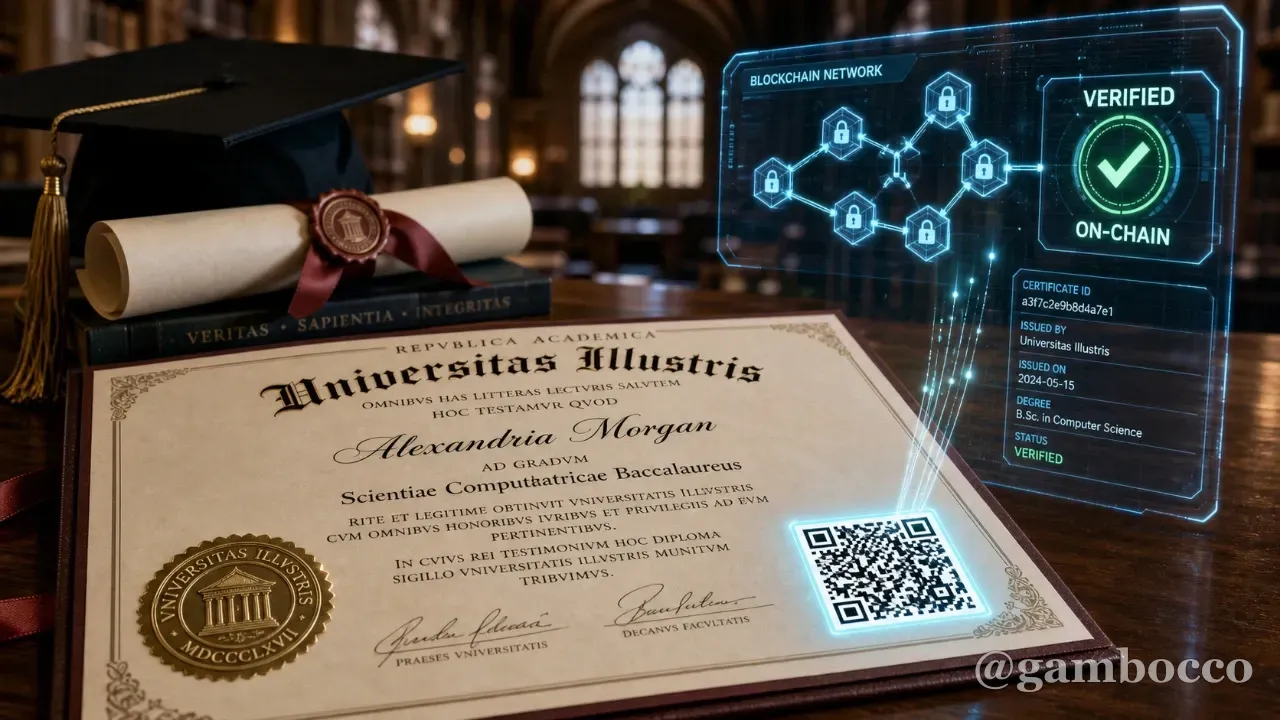
What Is Blockchain Degree Verification?
Blockchain degree verification is the practice of issuing academic credentials as tamper-evident, cryptographically signed tokens on a blockchain, held in a graduate's digital wallet and verifiable by anyone in seconds. It replaces the paper diploma + email-the-registrar workflow with a single QR-code scan.
Why It Matters: The Scale of Diploma Fraud
The FTC and multiple national accreditation bodies estimate that 1–3% of résumés in Europe and North America contain falsified academic claims — climbing to 20% or more in some emerging markets. Manual verification currently costs employers $10–$50 per candidate and takes days.
How the Verification Flow Works
- University signs the credential with its private key and mints it on-chain.
- Graduate receives the credential in a self-sovereign wallet (e.g., a W3C Verifiable Credential wallet).
- When applying for a job, the graduate shares a verification link or QR code.
- The employer's verification portal cryptographically checks: signature valid + not revoked + issuer accredited.
- Result appears in under 10 seconds, with zero calls to the university.
Universities Already Doing This
- MIT — Digital Diploma using Blockcerts (since 2017).
- ETH Zurich — piloted diploma NFTs for 2023 graduates.
- University of Melbourne, Central New Mexico Community College, University of Bahrain — full production issuance.
- European Blockchain Services Infrastructure (EBSI) — pan-European framework used by more than 50 universities across the EU.
The Employer Side
Platforms like Learning Machine (Blockcerts), Accredible, Parchment, and TrueCred offer employer verification portals. Many major employers (Deloitte, EY, KPMG) now accept verifiable credentials as first-class proof — reducing background-check turnaround from days to minutes.
Privacy: The Selective Disclosure Advantage
Zero-knowledge credentials let a graduate prove 'I hold a degree from an accredited institution' without revealing GPA, graduation year, or even the specific university. This selective-disclosure property is a step-change beyond paper diplomas.
Costs and Adoption Curve
Issuing a blockchain credential typically costs $0.05–$2 per credential, an order of magnitude cheaper than mailed transcripts. As of 2026, more than 350 universities globally issue at least some credentials on-chain, up from ~50 in 2020. See also proof of authenticity for businesses.